HAWAI‘I RELIEF PROGRAM FAQs – SUPPORT FOR HOUSING AND UTILITY PAYMENTS
Posted on Oct 29, 2025 in Main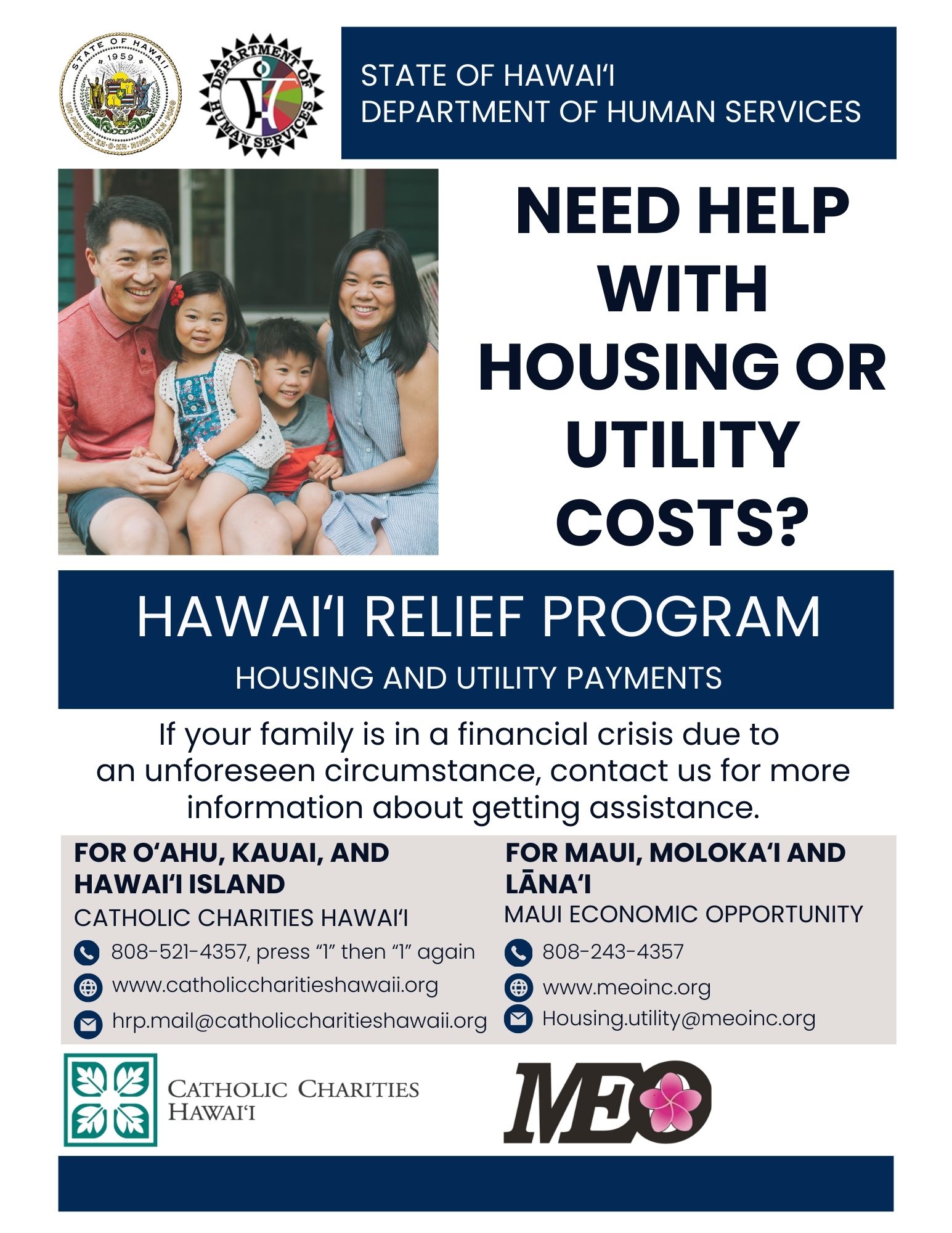
HAWAI‘I RELIEF PROGRAM FAQs – SUPPORT FOR HOUSING AND UTILITY PAYMENTS
- What is the Hawaiʻi Relief Program?
The Hawaiʻi Relief Program is a new statewide program that provides non-recurring short-term housing and utility payments to help families with dependent children who are in financial crisis or are experiencing an episode of financial need resulting from an unexpected event such as involuntary loss of employment, natural disaster, displacement from a damaged home, or involuntary reduction in earnings or financial resource.
Pursuant to the Governor’s Emergency Proclamation Relating to Homelessness, the Hawaiʻi Relief Program is another initiative developed by the Department of Human Services in an effort to help homeless families secure and maintain stable housing — and to prevent families from becoming homeless.
- What type of help can a family receive through the Hawaiʻi Relief Program?
An eligible family may receive help with the following:
- One-time housing deposit, actual cost up to a maximum of $6,000
- Housing payments, actual cost up to the maximum of $6,000, for up to four months
- One-time utility deposit, actual cost up to $3,000 for each utility source (electricity, water, gas)
- Utility payments, actual cost up to the maximum of $2,000, for up to four months
- What is considered a “family” for the purposes of the Hawaiʻi Relief Program?
A “family” includes an adult specified relative, (e.g., natural and adoptive parents, stepparents, siblings, aunts, uncles, grandparents, etc.), who resides with a dependent child under the age of 18 years, for whom they provide care and parental control. A family may also be a pregnant woman without a dependent child, who is in the third trimester of pregnancy.
- What are the eligibility criteria for the Hawaiʻi Relief Program?
The Hawaiʻi Relief Program is targeted at assisting families who are experiencing an episode of financial need or are in financial crisis and need help with housing or utility costs. A family may be eligible if:
- The family includes an adult specified relative and a dependent child under the age of 18 years, residing in the same household, or a pregnant woman without a dependent child who is in the third trimester of pregnancy;
- All family members are residents of Hawaiʻi;
- There is at least one family member who is a U.S. citizen; a qualified non-citizen; or is a citizen of the Federated States of Micronesia, the Republic of the Marshall Islands, or the Republic of Palau and is lawfully residing in the Hawaiʻi under the Compacts of Free Association (COFA);
- The family’s total gross income is below the eligibility guidelines for the program (see question #5 below);
- The family demonstrates an episode of need or financial crisis; and
- The family has not received other housing or utility payment assistance that may duplicate the payments provided through the Hawaiʻi Relief program.
- What are the income limits to qualify for payments through the Hawaiʻi Relief Program?
To be eligible for the housing and utility payments through the Hawaiʻi Relief Program, a family’s total gross income must be at or under 300% of the 2025 Hawaiʻi Federal Poverty level for the applicable family size.
| Family Size | Annual | Monthly | Family Size | Annual | Monthly | |
| 1 | $53,970 | $4,497 | 6 | $148,920 | $12,410 | |
| 2 | $72,960 | $6,080 | 7 | $167,910 | $13,992 | |
| 3 | $91,950 | $7,662 | 8 | $186,900 | $15,575 | |
| 4 | $110,940 | $9,245 | 9 | $205,890 | $17,157 | |
| 5 | $129,930 | $10,827 | 10 | $224,880 | $18,740 | |
| For each additional family member | $18,990 | $1,582 | ||||
- What is considered a “financial crisis” or an “episode of need” for the purposes of the Hawaiʻi Relief Program?
A “financial crisis” or an “episode of financial need” is when a family has an impending eviction or disconnection of a utility source because they are in arrears with their housing or utility payments or are currently homeless. The financial crisis or episode of financial need may have resulted from an unexpected event that caused the family’s financial instability. Examples of an “unexpected event” may include, but are not limited to:
- Involuntary loss of employment (e.g., layoff, reduction in workforce, etc.)
- Involuntary loss of income (e.g., furlough, reduction in work hours by employer, work-related injury, etc.)
- Medical emergencies (e.g., unforeseen medical issues, unexpected illness, etc.)
- Natural disaster
- Life events (e.g., death of a wage-earning family member, divorce, etc.)
- Displacement from a damaged home due to fire, flooding, etc.
- Are there documents that a family will need to provide besides their application, and if so, what documents?
Yes. In addition to submitting a valid application, a family will need to provide the following documents:
- Government-issued identification card for the applicant;
- Proof of Hawaiʻi residency for the family (e.g., rent/lease agreement, utility bill, SNAP or other public assistance letter, etc.);
- S. citizenship or immigration status for the applicant and members of the family (e.g., Hawaiʻi state ID, birth certificate, immigration card, U.S. passport, etc.);
- Verification of the family’s total gross income which includes unearned income (e.g., Social Security or SSI benefits, pension/retirement, worker’s compensation, unemployment insurance benefits, child support/alimony payments, etc.) and earned income (e.g., employment and self-employment);
- Rent/lease agreement or mortgage account statement (for housing payments); and/or
- Account for each utility expense requested.
- How long does it take until a family’s application is processed and notified whether they are eligible?
It may take up to thirty (30) calendar days for a valid application to be processed after it is received. However, it may take longer if the family still needs to submit necessary documents (see documents listed in question #7 above), in which case the family will be provided up to ten (10) calendar days to submit the necessary documents. The family’s application will be denied if the documents are not provided within the ten-day period.
There has been a greater need for housing and utility payments assistance through the Hawaiʻi Relief Program because of the recent federal government shutdown that financially impacted many Hawaiʻi resident families, particularly families who were furloughed and those who depend on SNAP for food security but their benefits were temporarily suspended by the federal government. As a result, the timeframe for applications to be processed may take longer than thirty (30) calendar days.
- Does a family need to receive Supplemental Nutrition Assistance Program (SNAP) benefits, financial assistance, or other types of government assistance to qualify for the Hawaiʻi Relief Program?
No. A family does NOT need to receive SNAP, financial assistance or other government assistance to qualify for housing or utility payments through the Hawaiʻi Relief Program. However, a family may not qualify if the family is currently receiving other government or private-funded housing or utility assistance that duplicates the housing or utility payments from the Hawaiʻi Relief Program.
- How can a family apply for housing or utility payments?
Catholic Charities Hawaiʻi and Maui Economic Opportunity, Inc., are contracted to administer the Hawaiʻi Relief Program for DHS, which accepts electronic and hard-copy applications. Electronic applications are accepted online through their website or via email. Hard-copy applications may be dropped off in person or mailed to the appropriate office location (see question #15 below).
- Why does a landlord or property owner need to provide a copy of their W9 and Hawaii General Excise Tax (GET) License?
A third-party payee designated by an eligible family, such as a landlord or property owner, must be compliant with federal and state laws that affect the third-party payee’s ability to do business in the state, including rules and regulations of the U.S. Internal Revenue Service and the Hawaiʻi Department of Taxation. Payments will be made to the designated third-party payee after compliance is verified.
- Is a family able to apply for both the housing and utility payments?
Yes. A family that is in financial crisis or experiencing an episode of financial need, based on their current needs, may apply for the housing payments, utility payments or both.
- How will an eligible family receive housing and utility payments?
If a family is determined eligible to receive housing or utility payments, or both, the payments will be sent directly to its designated third-party payee, which may be a landlord, property manager or owner, mortgage company or financial institution, or utility company, on behalf of the eligible family.
No payments will be issued directly to the family. This is to ensure that the payments will not be counted as income should the family apply for SNAP benefits, financial assistance benefits, child care subsidies, or other public assistance programs.
- Who is administering the Hawaiʻi Relief Program?
DHS has contracted the following community-based agencies:
Catholic Charities Hawaiʻi to administer the program on the islands of Kauaʻi, Oʻahu and Hawaiʻi Island.
Maui Economic Opportunity, Inc. to administer the program on the islands of Maui, Molokaʻi and Lānaʻi.
- How can a family get more information about the housing and utility payments through the Hawaiʻi Relief Program?
For more information and updates regarding the new statewide Hawaiʻi Relief Program, please contact the following:
Catholic Charities Hawaiʻi, for residents on Oʻahu, Kauaʻi and Hawaiʻi Island
Telephone Number: 808-521-4357, press “1” for financial assistance, and press “1” again for the Hawaiʻi Relief Program (HPR) Team.
Email Address: [email protected]
Website: https://www.catholiccharitieshawaii.org/hawaii-relief-program/
| Kauaʻi Office | ||
| 4373 Rice Street #1 | ||
| Lihuʻe | ||
| Honolulu Office | West Hawaiʻi Island Office | |
| 1822 Keʻeaumoku Street | 73-5618 Maiau Street | |
| Honolulu | Kailua-Kona | |
| Leeward Oʻahu Office | East Hawaiʻi Island Office | |
| 86-082 Farrington Highway #255 | 58 Kinoʻole Street, Suite 104 | |
| Waiʻanae | Hilo | |
Maui Economic Opportunity Inc., for residents on Maui, Molokaʻi and Lānaʻi
Telephone Number: 808-243-4357
Email Address: [email protected]
Website: https://www.meoinc.org/hawaii-relief-program-tanf-support-for-housing-and-utility-payments/
Online Application: https://app.smartsheet.com/b/form/3d429f59d6874122baedf6fb19d85913
| West Maui Office | East Maui Office |
| Harry & Jeanette Weinberg Family Center | Hāna Neighborhood Center |
| 99 Mahalani Street | Uakea Road |
| Wailuku | Hāna |
| Molokaʻi Office | Lānaʻi Office |
| 380 Kolapa Place | 1144 ʻIlima Avenue #102 |
| Kaunakakai | Lānaʻi City |
Please do not call or walk in to the DHS Processing Centers regarding questions about the Hawaiʻi Relief Program, as the Hawaiʻi Relief Program is separate from the SNAP or financial assistance programs and will not be processed through the DHS Processing Centers.